
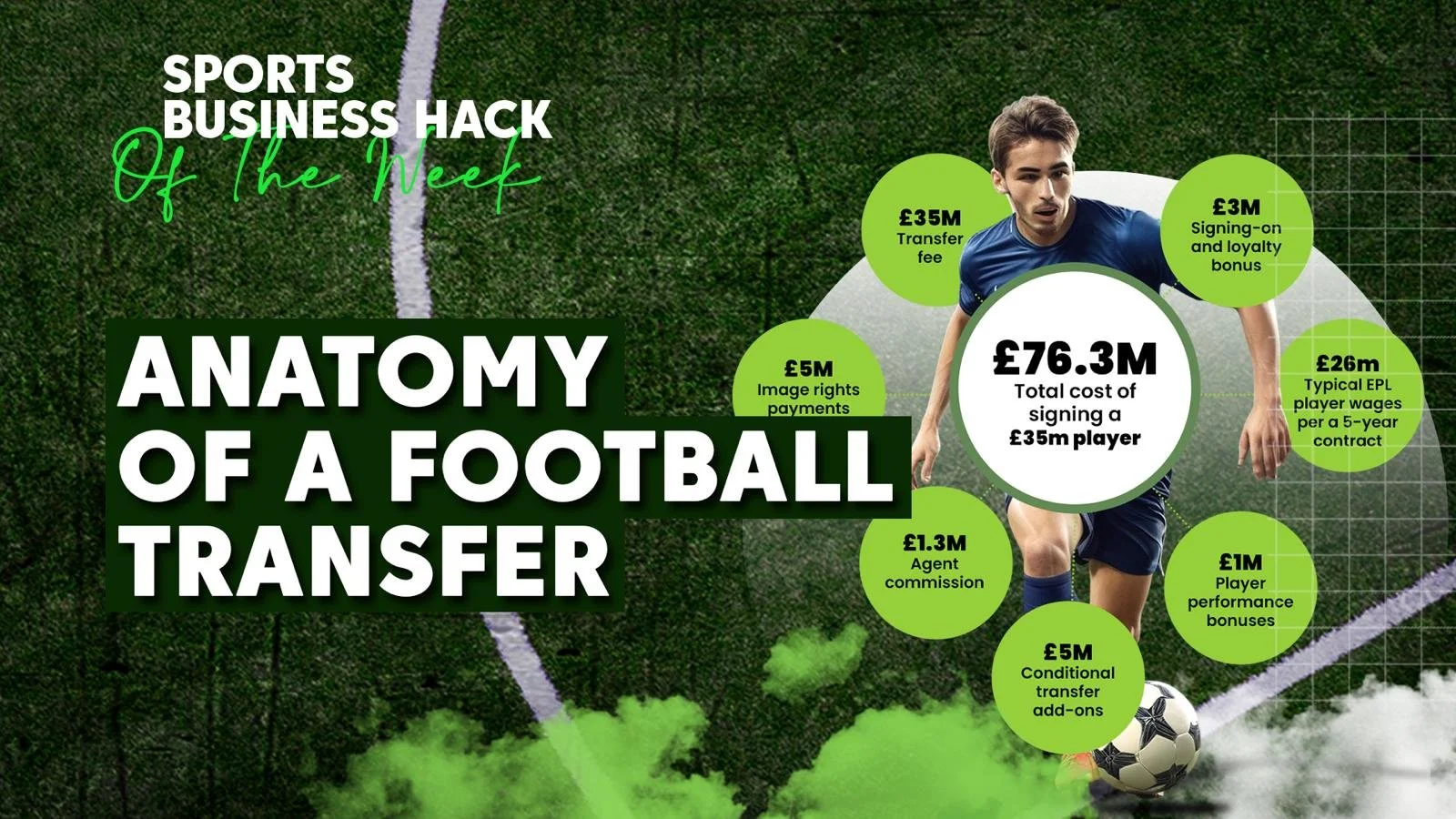
This week I'm going to break down how a £35 million Premier League transfer is really structured. Once you see the full picture, you won't look at a newspaper-reported transfer fee in the same way again.
When you see a Premier League transfer announced at £35 million, you're seeing one aspect of a complicated and moving negotiation, built of multiple contracts and structures that sit alongside it.
The Transfer Fee:
It's rare for the £35 million to be paid upfront. It's structured in instalments over 2, 3, sometimes 4 years. Usually interest-free, because clubs negotiate the payment schedules in the same way they negotiate the fee itself. Cash flow and Squad Cost Ratio (SCR) management play an important part in how this deal gets done.
That £35 million also rarely lands in the selling club's account in full. Chunks get carved off before they see anything.
Solidarity payments: 5% of the transfer fee distributed to every club that trained the player between the ages of 12 and 23, proportioned by years spent at each club.
Training compensation: a separate payment triggered when a player aged under 23 moves clubs, calculated: buying club's training category x years the player was trained there between ages 12 and 21.
Sell-on clauses: a % of the transfer fee owed to a previous club if negotiated as part of an earlier deal.
Player sell-on entitlements: a % of the transfer fee sometimes negotiated into the player's contract.
Debt set-offs: where a club has borrowed against the future sale of a player.
The selling club's net receipt on that £35 million headline can be significantly lower than anyone outside the deal would imagine.
But the buying club's total outlay is where this deal really stacks up.
Beyond the £35 million transfer fee:
£26 million in wages. A player on £100,000 per week over a 5 year contract. A fairly typical Premier League salary on a standard contract length.
£5 million in image rights. For a marketable player, image rights are paid into a separate company, usually controlled by the player or his family.
£3 million in signing-on and loyalty bonuses. Usually split 50/50. The signing-on bonus is paid in equal instalments at the beginning of every season. The loyalty bonus at the end of every season, conditional on the player still being at the club.
£1.3 million in agent commission. At 5% of the total contract value over 5 years. Some of this can be front-loaded, usually at a discount to the overall percentage.
£1 million in player performance bonuses. Goals, clean sheets, appearances, league position, cup runs. Negotiated individually and structured to reward contribution.
£5 million in conditional transfer add-ons. Paid by the buying club to the selling club when pre-agreed conditions are met, such as Champions League qualification or appearance thresholds.
Total cost to the buying club: £76.3 million
More than double the headline fee.
My advice this week:
If you want to work in the sports industry, separate yourself from the fan who reads the transfer fee and moves on.
Learn the structures, the detail, and the processes that make up the full composition of every deal.
Understanding distinctions such as these is what separates people who like to talk about football from people who operate inside the football industry.