
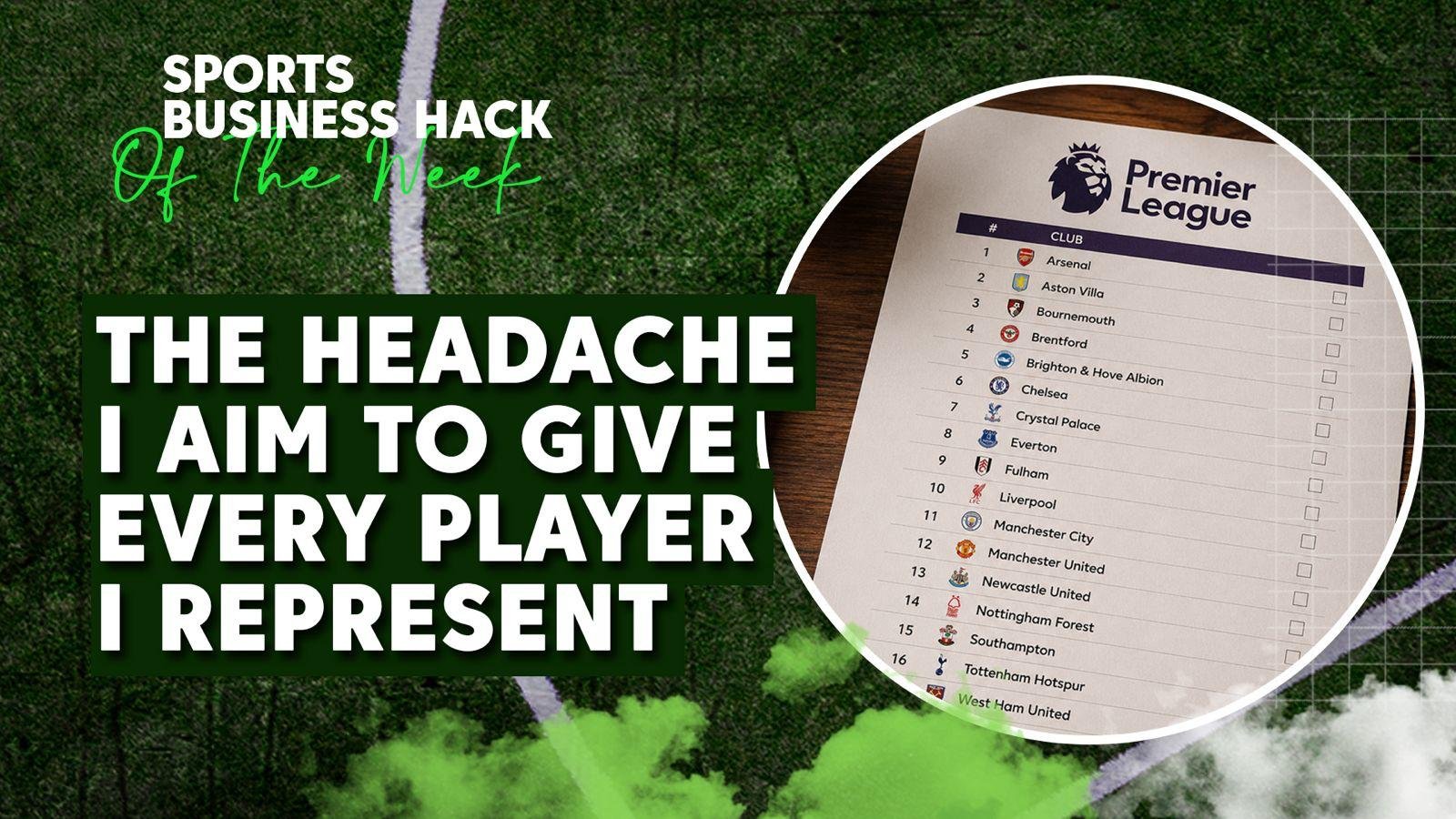
Long before a negotiation starts, I'll often sit down with a player and tell them something they find very confusing: Regardless of their appetite to join a particular club, I'm going to open discussions with that club anyway.
I often get pushback here:
Why waste time on a club I'll never sign for?
Why give them the impression I might be available when my mind is already made up?
The reason is that the conversation isn't really about that particular club. It's about establishing the full spectrum of what the player is worth, and you can't do that by only talking to the clubs they like.
Here's the composition:
A player will always have a first choice. It's natural. It's almost always driven by the football, the manager, the team's success, the history, the trajectory. For most players, what that first choice is rarely driven by is money, because a player has no idea yet what the real money looks like. Nobody does, in fact, until the market has been tested.
If you walk straight into that first choice club and start negotiating, you're negotiating blind.
They offer a number, and you've got nothing to measure it against. Very often, they'll attach a deadline to it. That's what I would do if I sensed the agent wasn't prepared, and if the agent had revealed the player's deep desire to join that club above any other. I'd weaponise that knowledge and attach a deadline to pressure a quick decision in my favour.
But if that happens to you and you haven't done the preparation work, you'll be exposed, scrambling to generate interest and leverage elsewhere with a clock running down to secure a deal at your player's first choice club.
You often end up with a below-par deal, or no deal at all. And, quite frankly, you're not doing your job correctly.
So I do the opposite. I go to the clubs lower down the list first, and I get a market value, a range bookended by two offers between which their first choice offer will eventually sit. And the lower down the preference list the club sits, the higher the number I pitch will be.
If that sounds counterintuitive, here's why:
At a club quite far down the pecking order, if the numbers are too high for the club and no offer is forthcoming. The player loses nothing. But...if they say yes to that number, we've now got a seriously high offer on the table from a club that has become a credible option.
And once I've done that across a few clubs, something useful has happened.
I've achieved my goal of giving my own player a headache.
Don't get me wrong, it's a good headache, because it's entirely in the player's service. They're now sitting with several genuine options, each strong in a different way. Some have numbers far bigger than anything they expected. The clubs that excited them the least on the pitch have become the most interesting financially.
And at this point I go to the clubs they originally wanted to join.
Because, in that meeting, when they put a number forward, we're no longer uninformed and unprepared. We're negotiating from a position of strength. The burden has shifted to the other side. They can either move towards the number that makes the player want to sign with them, or risk losing a player they actually wanted, and who wanted to come to them.
The principle is the same as the way a high anchor drags the other side towards a higher middle. Except rather than verbal anchors, these are concrete offers.
This strategy does two things:
1️⃣ IIt means every word you say at the table is true. I don't bluff, partly because it's risky and unnecessary, but mostly because if you've done the work, the facts are already on your side.
2️⃣ It turns the narrative from "please pay them what they deserve" into "this is what the market has already decided they're worth."
Same player, same club. The only thing that changed was the chronology.
This is called sequencing, and it's one of the most powerful skills in negotiation.
It's also just one of the 20+ negotiation techniques I teach on The Game Plan Sports Business Accelerator. Across the module I go through how the best negotiators set the stage, control timing, anchor numbers, counter anchor, use silence, and in many more ways build the leverage that gets deals done.