
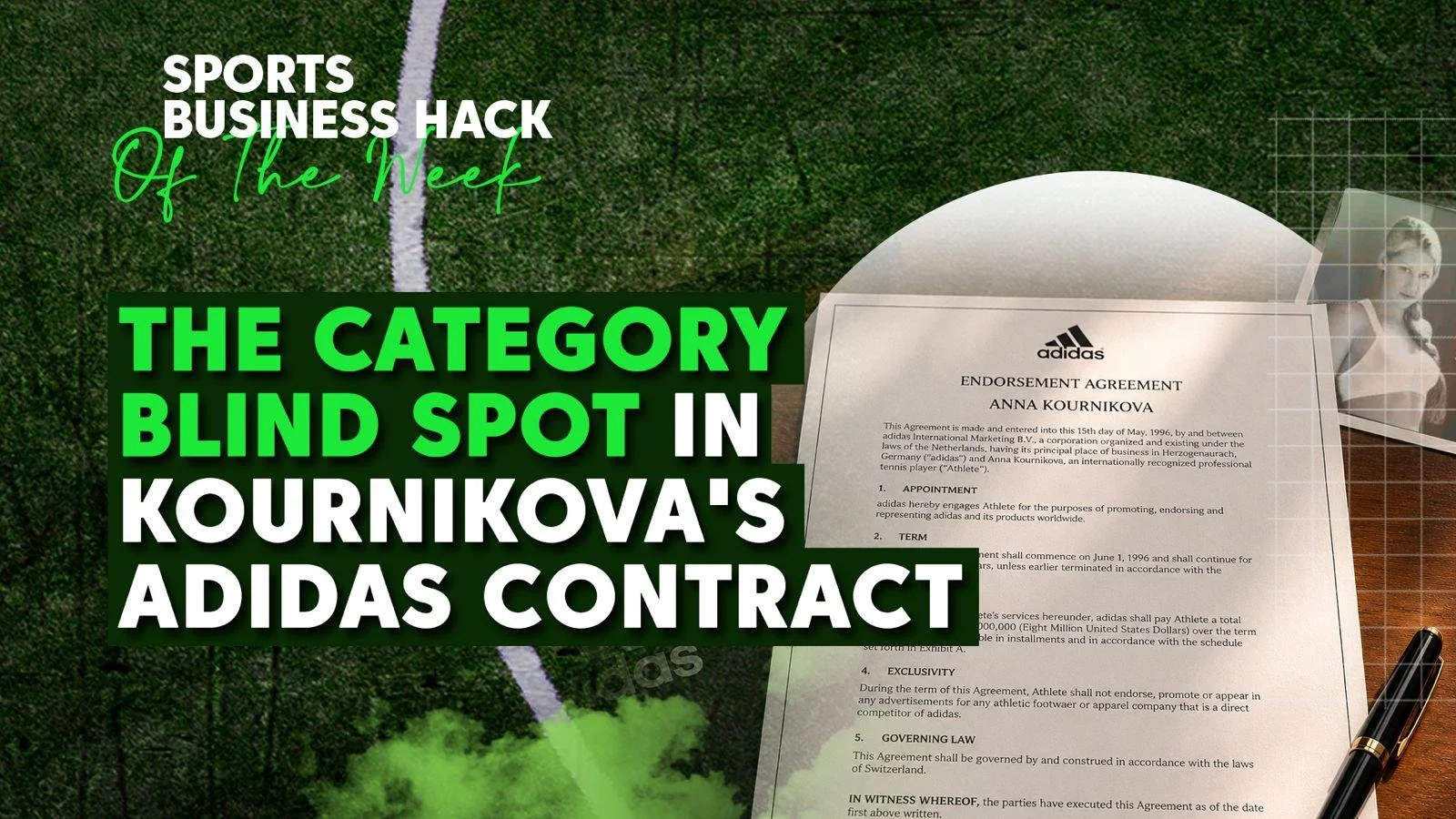
In 2000, Anna Kournikova was the most recognised athlete in the world and the highest-paid female athlete on the planet. Adidas had her on a full apparel deal.
So when a sports bra company called Shock Absorber approached her agents at Octagon about a campaign, Octagon almost didn’t take the meeting.
The hack this week comes from my friend Clifford Bloxham at Octagon. Clifford has been responsible for some of the best sports marketing and management deals over his time, and has helped me with several sections of the Sports Business Accelerator.
Shock Absorber were eventually given about thirty minutes over lunch at the end of a shoot day with another brand, because Octagon didn’t think the budget was there, and didn’t expect the conversation to go anywhere.
Shock Absorber pitched their idea, Anna as the face of a sports bra campaign. It was initially dismissed because of the Adidas deal until one sharp observer noted that the Adidas contract didn’t preclude a third-party sports bra deal.
It wasn’t that Adidas had been careless, rather that sports bras weren’t considered a sportswear category in 2000. Nobody had thought to lock the category because commercially, the category barely existed yet. The same was true of base layers before Under Armour built an empire out of them.
Shock Absorber’s marketing director came back with an offer that put her entire career on the line. She was trying to get her company to spend more on Anna than they had ever spent on anything.
And it worked spectacularly.
Shock Absorber more than doubled their global sales in year one. They broke into the US market where they had never previously sold a single unit, and America became their biggest territory. And the campaign itself, only the ball should bounce, is still remembered over twenty years later.
THERE ARE 4 LESSONS INSIDE THIS STORY:
1. Category exclusivity is always moving
2 weeks ago we looked at category creep from the brand’s side, how boot deals have quietly expanded to cover swimwear, underwear and sleepwear. This is the same concept but from the opposite side of the table. A new category emerges, the dominant brand hasn’t locked it yet, and a challenger walks in and builds an entire business around it.
Shock Absorber did it with sports bras. Under Armour did it with base layers. After the Kournikova deal ended, Adidas and Nike closed this loop hole for good.
The categories keep emerging. Recovery tech, Wearables, Sleep, AI, etc. Your job, whether you represent the athlete or the brand, is to know which categories aren’t locked in and scrutinise the contract.
2. Take the meeting
Octagon nearly cancelled twice. The only reason the meeting happened at all was that Shock Absorber kept pushing.
Five people ended up on the right side of that half-hour lunch. Shock Absorber more than doubled their sales and broke the US. Kournikova got royalty upside on every unit sold. Octagon banked a defining year. The Shock Absorber marketing director who put her whole career on the line walked away vindicated.
Five winners from a meeting nobody wanted to take.
3. When you have the leverage, take the upside.
The royalty on every sale is what turned Anna’s deal from a standard endorsement into a serious commercial outcome. She could only demand that because she had the dominant negotiating position. Shock Absorber needed her far more than she needed them.
It’s not dissimilar to Michael Jordan’s original Nike deal in 1984. Nike wanted him so badly that his agent was able to secure a royalty on every pair of Air Jordans sold. That one clause has since generated billions for Jordan and built one of the largest licensing businesses in the history of sport.
When your athlete is the one the brand needs, don’t settle for the fee. Take a share of the upside. Royalties, equity, option structures, the vehicle depends on the brand. The fee is just the floor.
4. Activation is as important as the Rights.
Only the ball should bounce is probably why most people still remember that Kournikova campaign. That advert gave the brand visibility that travelled far beyond the point of sale.
Most endorsement deals fail when brands spend the entire budget acquiring the rights, then have nothing left to bring the partnership to life. The athlete’s face ends up on a poster, a half-built campaign runs for six weeks, and the deal fades away.
The lesson from the brand side is to always reserve a substantial portion of the budget for activation. A smaller rights deal with a proper activation budget will consistently beat a larger rights deal with nothing left over to tell the story.
CLIFFORD'S LESSON FROM THE KOURNIKOVA DEAL:
If someone wants to spend money with one of your athletes, just take the meeting, even if you think it might not be going anywhere.