
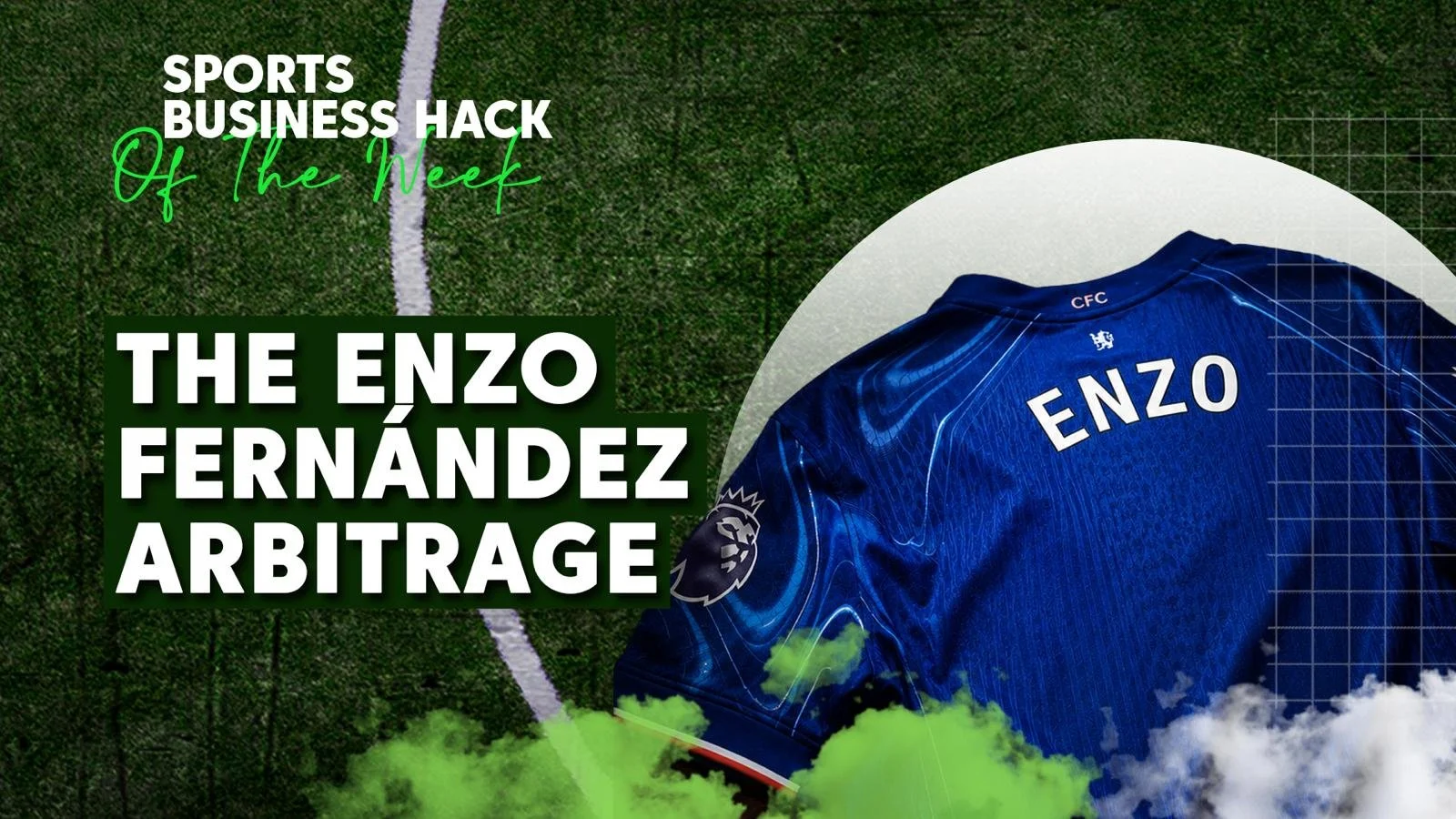
£10 million to £106 million in six months
On 7 July 2022, Benfica paid River Plate £10 million for a 21-year-old central midfielder. On 31 January 2023 (deadline day), Chelsea paid Benfica £106.8 million for the same player.
Six months. A tenfold difference in valuation.
To put that in wider context:
Nvidia's 2023 performance was celebrated as one of the great stock runs of the modern era, gaining approximately 239% across the calendar year. Tesla's 2020 surge, the most talked-about investment story on the planet, delivered around 700% across 12 months.
Enzo Fernandez returned 968% in 6 months. There is no publicly traded asset class generating returns of that magnitude, over that timeframe. That's what makes the Premier League's financial architecture so unique.
What actually happened?
I know the agent who held the UK sale mandate for Enzo in the summer of 2022. A good agent who would have worked the market properly. Yet, there were no Premier League takers.
And the primary reason is that Premier League clubs don't need to take risks on unproven players. They have the finances to wait, monitor, and buy with more data behind them. A move to an established European league gives them the benchmarks they need. They can compare directly against players they already know and trust.
A failed £50 million signing carries consequences well beyond the transfer fee itself. Wages, squad disruption, lost budget that could have gone elsewhere, and often the manager's relationship with the board. The risk calculus is real, and most clubs have learned to respect (or fear) it.
We all know the Premier League clubs enjoy financial architecture that clubs in other leagues simply cannot replicate. In the 2023/24 season, the bottom club in the Premier League received more central distribution than most top-flight clubs in France, Italy and Portugal combined.
But the cost of that caution, as the Fernandez arbitrage makes clear, can be extraordinary.
Benfica had the market proximity and the conviction to move without that safety net. They paid £10 million.
Then came the 2022 World Cup. Enzo played every minute of Argentina's campaign and won the tournament's Best Young Player award. Every technical director, scout and sporting director on the planet was watching the same player on the biggest stage in world football. The information asymmetry had collapsed entirely, and with it, any chance of acquiring him at a rational price.
Chelsea moved on deadline day in January. £106.8 million. A club & Premier League record at the time.
The European route model and its blind spots
Historically, the pathway from South America ran through Portugal or Spain first. A player proves himself in European football, clubs accumulate data, benchmark him against players they already understand, and move with more confidence. But the price usually reflects that confidence.
Brighton challenged that orthodoxy, but with one of the most sophisticated data operations in English football behind them and sensible entry prices to match. £4.5 million for Caicedo. £7 million for Mac Allister. Both loaned back to develop before being integrated properly. Caicedo left for £115 million. Mac Allister for up to £55 million. The model works, but it requires analytical infrastructure and patience that most clubs don't have.
🇪🇺 Also, whilst the European filter reduces risk, but it doesn’t eliminate adaptation chance, tactical misalignment, injury regression, or even cultural challenges
Falcao arrived at Manchester United in 2014 via Monaco
Di Maria came via Real Madrid the same summer, £59.7 million
Guido Carrillo arrived at Southampton in January 2018 from Monaco
All three had the data and the benchmarks, but the results didn't follow.
The Takeaway:
The European route reduces uncertainty, but the premium for that perceived safety is built into every fee regardless of outcome.
That pathway will remain the default for most, but the ones willing to expand their scouting networks and data infrastructure into less familiar markets will access these players before the rest of the market does.