
Buying the club costs less than every season that follows
KSI bought 20% of Dagenham & Redbridge in March, announced the Premier League as the target and started filming a docuseries for his 17 million YouTube subscribers. In April Tony Fernandes, the Malaysian entrepreneur who built AirAsia and owned QPR from 2011 to 2018, bought 40%.
My business International Sports Consulting has done business with both owners: negotiating the transfer of Kane Crichlow to Dagenham & Redbridge this summer 2026, and representing QPR in the transfer of Yeni Ngbakoto from Metz in 2016. So I know how a club in Dagenham's position recruits, and I know Tony Fernandes from the QPR years.
The playbook most celebrity-owned clubs run is the same. Fame draws unrivalled levels of attention; this attention and content gets converted into sponsorship revenue, that money funds a wage bill the rest of the division can't match, and the higher level of player wins the promotion. Then the next division needs a bigger wage bill. But as revenue grows, losses grow faster, and the owner's cheque needs to get larger at every step.
I have been advising investors for the last 4 years, and this is what I would suggest to KSI:
The acquisition is the cheap half, the maintenance is the expensive half, and there are 3 common traps between them:
1️⃣ The wage bill trap: Wrexham were bought for $2.5 million, revenue is up 28x to £33.3 million, and the loss in the promotion season went from £2.7 million to £15.2 million because costs grew 54% while revenue grew 25% (they then spent £34 million on players for the Championship and the owners had to recapitalise). Tom Brady's Birmingham lost £34.4 million winning League One on a wage bill of £38.9 million against £36.5 million of revenue, and the Championship judges losses over 3 seasons regardless of division, so the bill travels up with them. Salford, the original Wrexham, have absorbed more than £28 million of losses since 2014 to reach League Two, where the average gate is 2,800 and the salary cap is 60% of revenue.
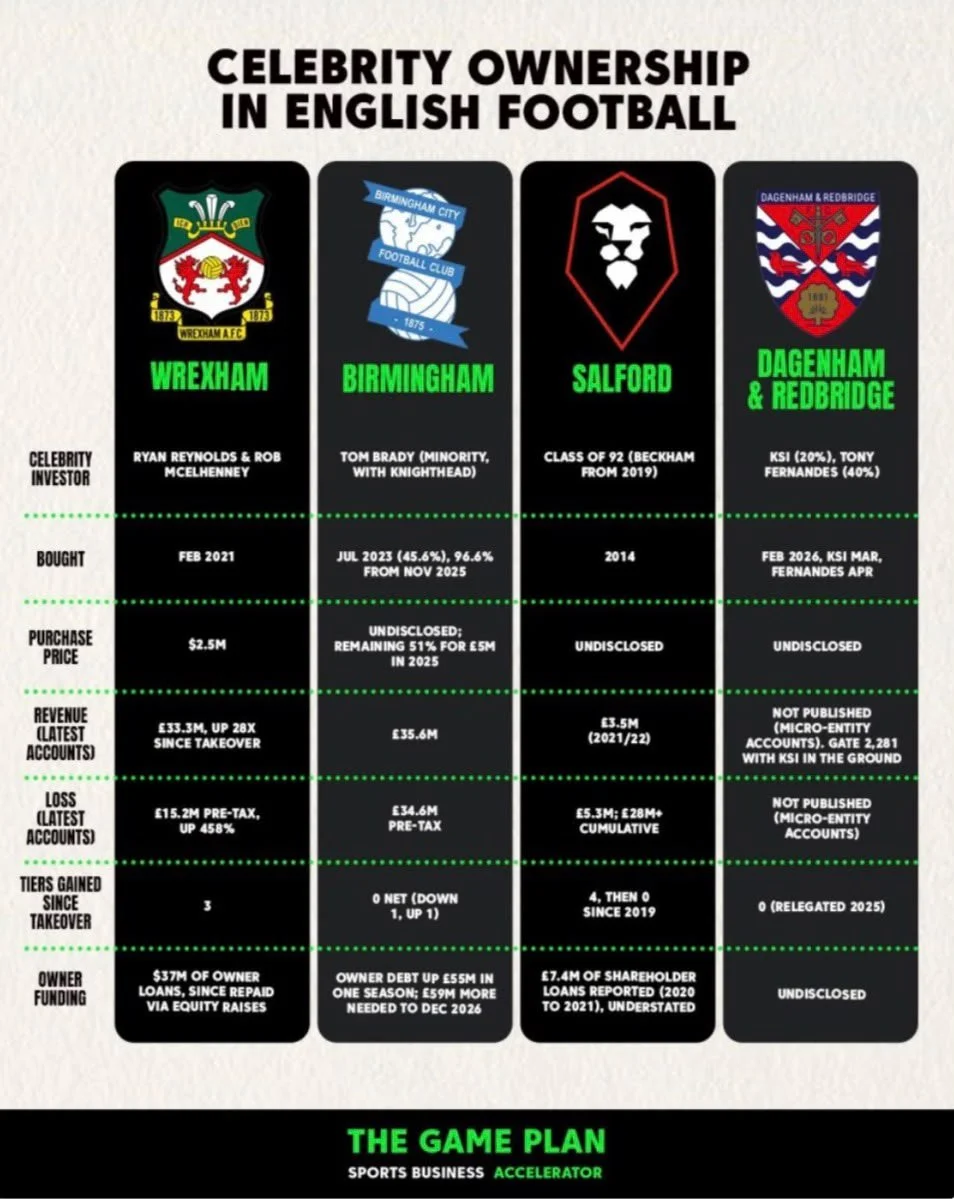
Latest published accounts: Wrexham and Birmingham 2024/25, Salford 2023/24 (revenue 2021/22, last reported). Dagenham & Redbridge files accounts without a profit and loss account.
The advice: set the wage bill for the division you're recruiting for and the losses you can fund for 5 seasons, and agree it with the other 80% before the first signing. Victoria Road holds 6,000 with 4 Premier League clubs a train ride away. Barnet have a 6,500 ground in north London, one of the most advanced in non-league, and it still took them 7 seasons and a record 102 points to get out of the National League, into a League Two they've been relegated from 3 times since 2001. That's the ceiling a London ground this size buys, whatever the reach. KSI's first home game as an owner nearly doubled the gate to 2,281, and the club's best-ever average was 2,770 in League One 15 years ago, which is the crowd Salford draw today after £28 million of losses.
2️⃣ The operator trap: Tony's love of football, of QPR and of people kept getting between him and the football decisions, and it cost the club money.
#1 He made Les Ferdinand Director of Football because he loved Les (a club icon and a man I personally like as well), and gave him nobody experienced alongside to show him how the job runs. Great players rarely make that switch, because the skillset is a different one.
#2 In February 2015 he tweeted that he'd found his dream manager, widely taken to be Paul Clement, Ancelotti's assistant at Real Madrid, while Chris Ramsey was already the caretaker at Loftus Road. Clement pulled out and Fernandes had to say he'd meant Chris all along.
#3 He was overly generous with the chequebook (and every agent knew it): an overcooked and injured Bosingwa arrived from Chelsea on a free with a 3-year deal on around £80k per week, the 8th signing of that summer, refused to sit on the bench against Fulham 4 months later, was fined £130,000, and the club went down that season. Tony has said himself he put in around £50 million, was exploited and learned a lesson. The £17 million FFP fine came later.
His 40% at Dagenham is the most interesting number in this story, because he has paid for the lessons KSI hasn't had yet, which will serve them both well.
The advice: hire the operator before the manager, give them the authority. Les Reed had 30 years in football administration before Marcus Liebherr gave him full authority over every football decision at Southampton, and that alignment, and the speed it allowed, took the club from a 10-point deduction in League One to the Premier League in 3 seasons. Wrexham brought him in before a pound went on players and have enjoyed the same trajectory.
3️⃣ Not showing up: this is the one people underrate, and with Wrexham's first-mover advantage gone and the returns on celebrity ownership diminishing every season, it's the one that now decides how powerful the asset is. Reynolds and McElhenney turn up. They're at the Racecourse for home games, they stay in Cheshire after the match, they drink at The Turf, and McElhenney counted 9 trips to the UK in 5 months, 8 of them to Wales. The fans see it, and the sponsors see the fans seeing it. Reynolds also ran the commercial side out of his own black book and his own diary: the TikTok shirt, United Airlines, the Super Bowl ads. That costs personal time and it can't be handed to an agency. Salford is the counter-example, where Beckham had 88 million followers and nobody turned him into a content property.
The advice: KSI's 33.5 million reach and a YouTube series get him the attention. What decides it is how many Saturdays he spends at Victoria Road when Prime, the boxing and Baller League all want the same weekend. Summary: be in the ground, be in the town, and spend your own hours on the sponsors and the network, because that's the one thing the club can't do without you.
💡 Lesson: fame buys the attention. The operator, the wage bill and the turning up buy the promotion, and only 1 of those 3 can be delegated.